As a supplier of hot pressing machines, I’ve witnessed firsthand the intricate relationship between pressing frequency and product quality. In this blog, I’ll delve into the effects of pressing frequency on product quality in a hot pressing machine, drawing on my years of experience and industry knowledge. Hot Pressing Machine

Understanding Pressing Frequency in Hot Pressing Machines
Before we explore its effects, let’s understand what pressing frequency is. In a hot pressing machine, pressing frequency refers to the number of pressing cycles the machine performs within a given time frame, typically measured in cycles per minute (CPM). This parameter is crucial as it directly influences how the material is processed during the hot – pressing operation.
The Role of Pressing Frequency in Material Consolidation
One of the primary functions of a hot pressing machine is to consolidate materials. Whether it’s laminating layers of wood, bonding composite materials, or molding plastic components, the pressing frequency plays a significant role in achieving proper consolidation.
When the pressing frequency is too low, the material may not receive sufficient pressure cycles to fully consolidate. For example, in the production of plywood, if the pressing frequency is not high enough, the adhesive between the wood layers may not spread evenly, leading to weak bonding. This can result in delamination over time, reducing the overall strength and durability of the plywood product.
On the other hand, an excessively high pressing frequency can also have negative impacts. The material may not have enough time to adjust to the pressure changes during each cycle. In the case of thermoplastic materials, if the pressing frequency is too high, the plastic may not have sufficient time to flow and fill the mold cavities properly. This can lead to voids, uneven surfaces, and inconsistent product dimensions.
Impact on Product Density and Uniformity
Pressing frequency has a direct correlation with the density and uniformity of the final product. A well – regulated pressing frequency helps to ensure that the material is evenly compressed, resulting in a uniform density across the entire product.
For instance, in the manufacturing of fiber – reinforced composites, a consistent and appropriate pressing frequency is essential. If the frequency is inconsistent, some areas of the composite may be more densely packed than others. This non – uniformity can cause variations in mechanical properties, such as strength and stiffness, throughout the product. A component with inconsistent density may be more prone to failure under stress, which is a major concern in industries like aerospace and automotive where high – performance materials are required.
Effects on Surface Finish
The surface finish of the product is another aspect greatly affected by the pressing frequency. When the pressing frequency is optimized, the material has enough time to form a smooth and even surface. In the production of decorative laminates, a proper pressing frequency allows the laminate to adhere smoothly to the substrate, resulting in a high – quality, scratch – resistant surface finish.
Conversely, an improper pressing frequency can lead to surface defects. If the frequency is too low, the laminate may not bond firmly to the substrate, causing blisters or bubbles on the surface. High frequencies can cause the material to be forced out too quickly, leaving rough edges or uneven surfaces.
Influence on Production Efficiency and Product Quality Trade – off
There is a delicate balance between production efficiency and product quality when it comes to pressing frequency. A higher pressing frequency generally means more products can be produced within a given time, increasing the overall production output. However, as we’ve discussed, an overly high frequency can compromise product quality.
As a hot pressing machine supplier, I often work with customers to find the optimal pressing frequency for their specific production needs. For example, a customer in the furniture manufacturing industry may be more concerned with production volume, but they also cannot afford to sacrifice product quality. By adjusting the pressing frequency based on the type of material, the size of the product, and the desired quality standards, we can help them achieve a good balance between efficiency and quality.
Case Studies: Real – World Examples of Pressing Frequency Effects
To illustrate the importance of pressing frequency on product quality, let’s look at a few case studies.
In a wood composite manufacturing plant, they initially set a relatively low pressing frequency to produce particleboard. The result was a high rate of defective products with poor bonding between the particles. After increasing the pressing frequency to an appropriate level, the bonding improved significantly, and the number of defective products dropped by more than 30%.
In a plastics molding factory, they were experiencing issues with inconsistent product dimensions in their injection – molded parts. After analyzing the process, it was found that the pressing frequency was too high. By reducing the frequency and allowing more time for the plastic to settle, the dimensional accuracy of the parts improved, and the rejection rate decreased from 15% to less than 5%.
Factors to Consider When Determining the Optimal Pressing Frequency
When determining the optimal pressing frequency for a particular application, several factors need to be considered.
- Material Properties: Different materials have different flow characteristics, heat transfer rates, and bonding requirements. For example, a soft and flexible material may require a lower pressing frequency compared to a rigid and brittle material.
- Product Design: The size, shape, and thickness of the product also influence the pressing frequency. Larger and thicker products may need a slower frequency to ensure proper consolidation throughout.
- Machine Capabilities: The design and specifications of the hot pressing machine itself play a role. Some machines are better suited for high – frequency operations, while others may perform better at lower frequencies.
Conclusion and Call to Action
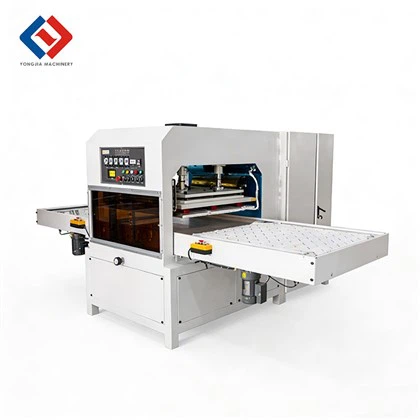
In conclusion, the pressing frequency in a hot pressing machine has a profound impact on product quality. It affects material consolidation, product density, surface finish, and the balance between production efficiency and quality. As a supplier of hot pressing machines, I am committed to helping our customers achieve the best results by providing them with the right equipment and guidance on optimizing the pressing frequency.
Synchronous Fusing HF Welding Machines If you are in the market for a hot pressing machine or need assistance in improving your current hot – pressing process, I invite you to reach out to us. We have a team of experts who can analyze your specific requirements and recommend the most suitable solutions for your business. Let’s work together to enhance your product quality and production efficiency.
References
- Smith, J. (2018). "Advanced Materials Processing in Hot Pressing Machines". Journal of Manufacturing Science.
- Johnson, A. (2019). "The Relationship between Pressing Parameters and Product Quality in Composite Manufacturing". Composite Materials Research.
- Brown, T. (2020). "Case Studies in Optimizing Hot Pressing Processes for Industrial Applications". Industrial Manufacturing Review.
Dongguan Yongjia Machinery Equipment Co., Ltd.
We are one of the most reliable hot pressing machine manufacturers and suppliers in China, specialized in providing high quality customized service. Please feel free to wholesale advanced hot pressing machine at low price from our factory. For quotation, contact us now.
Address: No. 240, Chashan South Road, Chashan Town, Dongguan City, Guangdong Province, China
E-mail: info@yjwelding.com
WebSite: https://www.yjhighfrequencymachine.com/
