If you’ve ever stood next to a skid steer loader, craning your neck to look at that big, solid metal block sticking out of the back before sliding into the operator’s seat, you’ve probably wondered, “What even is that?” I get it—when I first started working with these machines over a decade ago, I thought it was just extra weight to make the thing look tough. Spoiler: there’s way more to it than that. And as someone who’s spent years selling skid steers (and troubleshooting 100s of them for customers—hey, I’m that supplier who still answers after-hours texts when a load won’t lift), I can tell you that the counterweight isn’t just a random chunk of steel. It’s the backbone of how your skid steer works, and skip getting this right, you’re gonna be making way more trips to the shop than to the job site. Skid Steer Loader
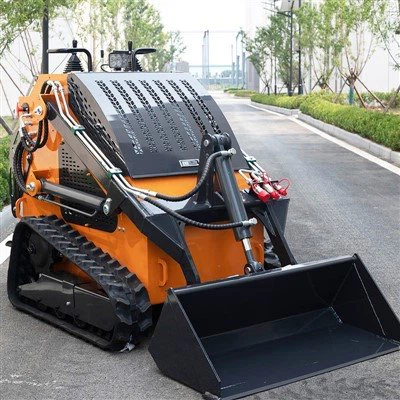
Let’s start with the basics, no jargon promise. A skid steer’s whole thing is that it has a lift arm up front for buckets, forks, grapples, whatever attachment you’re running. When you stack 2,000 lbs of dirt into that front bucket, or hoist a 3,000 lbs pallet of concrete blocks, that weight wants to tip the machine forward, right? Like when you lean too far out of a canoe—you go for a swim, and your skid steer’s front end drops so low it can’t steer, or even worse, the whole thing topples onto its face. That’s where the counterweight comes in. It’s that steel block at the back that balances out all that heavy stuff up front. Simple enough, but there’s actual science here, not just “add weight to the back.”
First off, counterweights aren’t one-size-fits-all. When we design a skid steer, we start with how much lift capacity we want. A compact mini skid steer (the ones you fit through a 36-inch gate) only needs a small counterweight—like 500-800 lbs—because it can only lift 1,500 lbs max. But a full-size vertical lift skid steer (the workhorse for construction, demolition, big landscaping) that lifts 5,000 lbs? That counterweight is usually 2,000 to 4,000 lbs. Wait, why so heavy? Because physics dictates that when you have a load on the lift arm, the counterweight’s mass times how far back it sits from the machine’s center is equal to the load’s mass times how far forward it sits. That’s torque balance, plain and simple. Too little counterweight, and even a moderately full bucket at the top of the lift will tip you forward. Too much, and you’re wasting fuel—more weight means the engine has to work harder to move the machine, especially on hills or loose dirt. We see this all the time with budget skid steers from no-name brands—they skimp on counterweight to cut costs, so you can barely lift a full load on a level surface, forget about uphill.
Now, you might notice some counterweights aren’t just solid steel blocks. Some have cutouts, or even little storage compartments, or are made from cast iron instead of rolled steel. Why the difference? It all comes down to balancing weight, space, and durability. Cast iron is denser than steel, so you can get the same balancing power in a smaller package. That’s a big deal for compact skid steers, where every inch of space matters—you don’t want a massive weight sticking out the back that makes it impossible to back up to a trailer or fit through a gate. On the flip side, heavy-duty skid steers for demolition need that extra bulk, and solid steel or cast iron can take a beating from falling debris, no dents or cracks from a stray wrecking ball. We even make custom counterweight adapters for some of our customers who do specialized work—like forestry with heavy grapples—they can swap a standard counterweight for a heavier one without modifying the frame, which is a game-changer for small contractors who don’t want to buy a whole new machine for one job.
Wait, another thing you might not have thought about: where the counterweight is mounted. It’s not just bolted haphazardly to the back of the chassis. On most skid steers, it’s attached directly to the frame, right over the rear axles. That’s intentional too. The rear axles are the pivot point for tipping, so putting the counterweight right over them means the balancing force is applied where it needs to be, not further back where it doesn’t help. If you mount it too far back, you’ll get rear-heavy stability issues—you’ll tip backward when you drive up a steep hill or lift a heavy load while going uphill. I’ve had customers call me at 7 a.m. panicking because they rolled their skid steer backwards down a driveway, and 9 times out of 10, it’s because they had too much counterweight or it was mounted wrong.
And here’s a pro tip for anyone who owns or rents a skid steer: you can’t just add random weights to the back if you need more lift. I know, I know, you think a few bags of concrete or a big chunk of metal will do the trick, but that’s a terrible idea. Adding extra weight changes the machine’s center of gravity completely, and even if you get more lift, you’re way more likely to tip. We had a guy last year who tried this on a job lifting steel beams—added two 1,000 lbs concrete blocks to the back—and ended up tipping the skid steer backward when he lifted a 2,500 lb beam 10 feet in the air. Totaled the machine, he was out thousands, and he swore he saved money by not buying the optional heavy counterweight from us. Don’t be that guy.
Now, as a supplier, I’ll be real with you—counterweights might not sound sexy, but they’re one of the most important parts of a skid steer’s performance and safety. That’s why we don’t cut corners on ours. Every skid steer we sell goes through torque testing for counterweight balance, so you don’t have to worry about tipping under load. We even label the lift capacity for every attachment so you know exactly what you can safely lift, no guesswork.
If you’re in the market for a skid steer, or you’re upgrading yours, don’t sleep on the counterweight. Ask your supplier about the counterweight specs—what’s it made of, how much does it weigh, is it adjustable for different lift capacities? If they can’t answer that, that’s a red flag. Our team can walk you through exactly what counterweight you need based on your work—whether you’re a landscaper lifting pallets of sod, a contractor digging foundations, or a demo guy tearing out old buildings. We’ll even let you test drive a skid steer with different counterweight setups to feel the difference, because nothing beats hands-on experience.

If you’re tired of dealing with a skid steer that won’t lift full loads, or you’ve had close calls with tipping, reach out. We don’t do sales pitches that sound like robot scripts—we talk like fellow contractors who’ve been there, seen the mistakes, and fixed them. Whether you need a new skid steer, a custom counterweight adapter, or just someone to walk you through loading a bucket safely, we’re here to help.
Double Mast Aluminum Alloy Lift Reference:
- Skid Steer Loaders: Design, Operation, and Maintenance (Construction Equipment Association)
- Agricultural Equipment Technology Handbook (ASABE Standards)
- Operator Safety Guidelines for Compact Construction Equipment (OSHA)
Shandong Zhongke Huali Machinery Co., Ltd.
As one of the most professional skid steer loader manufacturers and suppliers in China, we also support customized service. We warmly welcome you to wholesale discount skid steer loader in stock here from our factory. For price consultation, contact us.
Address: No. 2 Qubai Road, Qudi Street, Jiyang District, Jinan City, Shandong Province
E-mail: hlizhonggong@163.com
WebSite: https://www.hualiheavy.com/
