Hey everyone! If you’ve ever stopped to think about how those small DC motors powering your laptop’s cooling fan, the window regulator in your car, or even the toy you gave your kid last Christmas work, you’ve probably wondered—what actually controls them to do exactly what we need? As a DC motor supplier that’s been in the game for over a decade, I talk to engineers, small business owners, and hobbyists every week who get stumped by this exact question. It’s not just for academics, either; getting the control method right can make or break a project—whether you’re building a robotic arm for a warehouse, a medical pump, or just a better phone stand. Let’s break this down simply, no jargon overload, and share what we’ve learned from working with thousands of customers over the years. DC Motor

First, let’s start with the basics: DC motors run on direct current, right? But raw power from a battery or wall outlet doesn’t come with a “volume knob” or a way to set exactly how fast the motor spins, or to make it spin forward, reverse, or stop dead in its tracks. That’s where control methods come in—they’re the tools we use to adjust the motor’s speed, direction, and torque to match what a system needs. And here’s the thing: it’s not one-size-fits-all. What works for a tiny 5V motor in a wearable device is totally different from what’s needed for a heavy-duty 48V motor in an automated conveyor. Let’s go through the most common ones, how they work, and when we’d recommend each.
First up, the OG: Direct Control (AKA Full-On/Full-Off Control). If you’ve ever powered a small motor just by hooking it straight to a battery with an on/off switch, that’s direct control. It’s super simple, cheap, and no fancy electronics needed. But it has a big downside—you can’t adjust speed, really. Either the motor is running at full speed or not at all. A lot of our customers use this for things like conveyor belt systems that only need two settings: “on” to move parts, “off” to stop. But wait, there’s a twist on this called Pulse Width Modulation (PWM) that’s way more popular now. Let’s talk about PWM because it’s the workhorse of DC motor control, and if you’re working with our motors, you’ve almost definitely interacted with PWM even if you didn’t know it.
PWM is basically tricking the motor into thinking it’s getting less power by turning the current on and off super fast—like, hundreds or thousands of times per second. The ratio of “on” time to total time is called the duty cycle. A 100% duty cycle means the current is always on, so full speed. A 50% duty cycle means it’s on half the time, off half the time, so the motor averages half the speed. Here’s why this works: DC motors have inertia, so they don’t have time to slow down and speed up with each pulse. They just feel the average voltage. I remember a customer a few years back building a line of DIY drones—they were using cheap DC motors and trying to adjust speed with a potentiometer, but they kept burning out the motors because the potentiometer was wasting power as heat. Once we suggested PWM control, they cut their motor failure rate by 70% and extended drone flight time by 20%. That’s the kind of practical win we love to see. PWM is great for most low to medium power apps, it’s easy to integrate with Arduino or Raspberry Pi for hobbyists, and it’s energy efficient. It’s not perfect, though—at very low duty cycles, you might get a little vibration or noise, which isn’t a big deal for a fan but can be annoying for a robotic arm.
Next, if you need way more precision, like holding a robot arm steady at a certain angle or making a medical pump dispense exactly 1mL of fluid every second, you’ll need Closed-Loop Control. Unlike the methods above, which are “open-loop” (they just send power to the motor and hope it does what you want), closed-loop uses feedback to adjust. The most common feedback tool for DC motors is an encoder—little device that counts how many times the motor’s shaft spins, or its position, and sends that data back to the controller. If the encoder says the arm is moving 10 degrees too slow, the controller cranks up the PWM duty cycle. If it’s moving too fast, it dials it back. We work with a lot of automation companies that rely on this—one of our clients makes automated packaging machines that count boxes by the speed of their conveyor. Without closed-loop control, the conveyor would speed up when it’s loaded heavy, drop boxes, and cause backups. With encoders, they stay consistent, even when running 24/7. There’s also another type of closed-loop control called PID control (Proportional-Integral-Derivative) which is basically an algorithm that adjusts the motor in real-time based on that feedback. It’s a bit more complex to set up, but once it’s calibrated, it’s rock solid. We usually include PID-compatible controllers with our high-precision DC motors because most of our B2B customers don’t want to waste time tweaking that themselves.
Wait, what about direction control? Because motors don’t just spin one way, right? A lot of systems need to reverse—like a garage door opener, or a drawer that opens and closes in an office machine. The most common method here is H-Bridge control. The H-Bridge is a circuit with four switches arranged in an H-shape around the motor. When you turn on two opposite switches, current flows one way through the motor, making it spin forward. Flip the other two switches, and current reverses, so the motor spins backward. The great thing about H-Bridges is you can combine them with PWM, so you can adjust speed and direction at the same time. That’s exactly what’s in the window regulators in your car—one button rolls it up, another rolls it down, and the speed stays smooth whether you’re moving it fast or slow. We sell a lot of integrated H-Bridge modules for small motors, but for larger industrial motors, we work with customers to build custom H-Bridge setups that can handle higher voltage and torque without overheating. One thing to watch out for with H-Bridges: you can’t turn on both left switches or both right switches at the same time— that shorts the circuit and can damage the motor. It’s a common newbie mistake, but we always include a quick guide explaining how to avoid that when we ship our motors.
Now, let’s talk about some newer control methods that are popping up, especially for smaller, smarter devices. Brushless DC (BLDC) motors are super popular now because they’re more efficient and longer-lasting than brushed DC motors, and their control method is a bit different. Brushed motors use physical brushes to transfer current to the spinning part, so control is simpler, but BLDCs have no brushes—they use electromagnets, so you need a controller that switches current to the different windings on the stator in the right order to make the shaft spin. That’s called sensorless control sometimes, where the controller detects the position of the shaft by measuring back EMF (electromotive force) from the motor windings, instead of using an encoder. Sensorless is cheaper, but it doesn’t work well at very low speeds, so we still recommend sensor-based BLDC motors for apps that need slow, precise movement, like prosthetic limbs. A lot of our medical device customers go for BLDC motors because they’re silent and low-maintenance, and their control methods let them adjust speed super smoothly, which is important for things like insulin pumps that need to deliver tiny doses.
Let’s also address a common question we get: what’s the difference between DC motor control and AC motor control? A lot of people mix them up, but AC motors run on alternating current, so their control methods are totally different—most use variable frequency drives (VFDs) to adjust frequency to change speed. DC motors are way simpler for most low to medium power apps, which is why we focus on DC motors as a supplier. VFDs are overkill for a small robot or a desk fan, and they’re more expensive, too. We’ve had customers come to us after buying an AC motor for a small project, realizing it was way more complex than they needed, so we point them to the right DC motor and control setup every time.
Now, let’s talk about how we, as a DC motor supplier, make this easy for our customers. We don’t just sell motors—we help you pick the right control method. If you’re a hobbyist building a robot for a school project, we’ll point you towards a 12V brushed motor with a cheap PWM controller and H-Bridge module, and send you a link to a tutorial to set it up. If you’re an engineer building a industrial conveyor that needs to run 10 hours a day, we’ll recommend a high-torque brushless DC motor with an encoder and PID closed-loop control, and even work with you to customize the controller to fit your system. We’ve had customers come to us with a vague idea—“I need a motor that can move a 50lb object back and forth”—and walk them through choosing H-Bridge control, a motor with enough torque, and even suggest a power supply to go with it. That’s the stuff that matters, not just shipping a motor and leaving you to figure it out.
Wait, let’s talk about common pitfalls we see with control methods. One big one is under-sizing the controller. A motor might be rated for 10A, but if you get a controller that only does 5A, it’ll overheat and burn out, fast. We always make sure our customers check the motor’s voltage and current requirements, and recommend a controller that can handle at least 20% more than that, for safety. Another pitfall is ignoring heat. When you’re running PWM at high duty cycles for long periods, or running H-Bridges, the circuits generate heat, especially for high-power motors. We build motors with heat sinks for industrial use, and we include thermal protection in our controllers to prevent damage. A lot of hobbyists skip that, and end up with a motor that dies after a few uses. It’s not fun, which is why we make those details clear on every product page.
Also, let’s mention torque control, which is another big part of DC motor control we didn’t touch on yet. Torque is the twisting force the motor exerts, right? Some systems don’t just need speed or position—they need a set amount of torque. For example, a robotic gripper that can’t squeeze too hard and damage a part, or a winch that needs to lift a specific weight without overloading. Torque control usually uses closed-loop feedback too, often measuring the current draw of the motor (since torque is roughly proportional to current in DC motors) to adjust the power. We recently worked with a customer building parts for electric vehicles—they needed a DC motor for the window’s seat adjuster that could pull exactly 15Nm of torque, no more, no less. We supplied a motor with a current-based torque controller that calibrated perfectly, and they haven’t had a single complaint in two years of production. That’s the kind of reliable control that makes our customers come back.
At the end of the day, the right control method comes down to what you need the motor to do. If you need simplicity and low cost, PWM and H-Bridge control are hard to beat. If you need precision, closed-loop with encoders and PID is the way to go. If you’re dealing with brushless motors, you’ll need to adjust the winding current to get the speed and direction right. And as a DC motor supplier, our job is to help you navigate that, not just sell you a product. Whether you’re a first-time builder or a seasoned engineer, we’ve got the expertise to point you in the right direction.
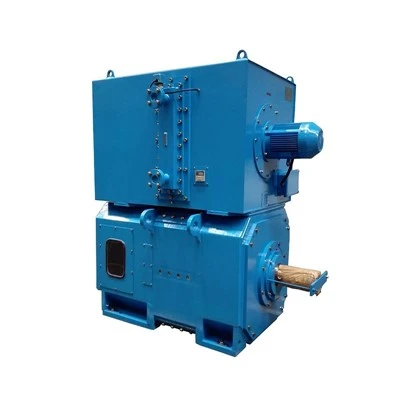
Large Synchronous Motor If you’re working on a project and aren’t sure which control method you need, or you’re looking for a reliable DC motor to pair with a controller, we’re here to help. We’ve supported everything from small hobby projects to large industrial operations, and we can help you pick the right setup for your exact needs.
References
- Dobbs, M. (2021). DC Motor Control: Theory and Application. Industrial Motor Control Press.
- El-Hawary, M. E. (2019). Electric Motors and Drives: Fundamentals, Types, and Applications (3rd ed.). IEEE Press.
- Bolton, W. (2020). Mechatronics: Principles and Applications (6th ed.). Newnes.
- NASA. (2022). Basic DC Motor Control for Small Spacecraft. NASA Engineering Technical Reports.
- American National Standards Institute (ANSI). (2021). Safety Standards for Electric Motor Control Systems. ANSI B11.1.
Xian Putai Electric Motor Equipment Co., Ltd.
Xian Putai Electric Motor Equipment Co., Ltd. is one of the most professional dc motor manufacturers and suppliers in China, also supports customized service with low price. Welcome to buy advanced dc motor in stock here from our factory. If you have any enquiry about quotation, please feel free to email us.
Address: Haibo Guangchang Fengcheng Nine Road Economical & Technological Development District Xi’an City Shaanxi Province – China
E-mail: sales@putaimotor.com
WebSite: https://www.putaimotor.com/
